Which private engineering colleges are affiliated to Tribhuvan University?

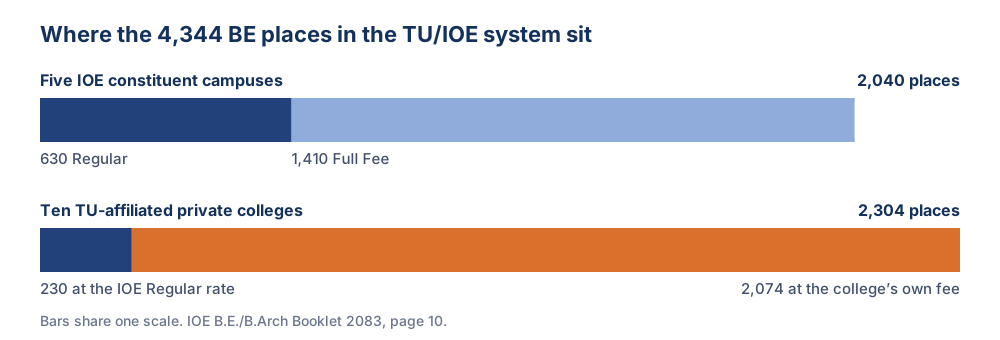
Ten, listed in IOE’s own 2083 booklet. Six are in Lalitpur, two in Bhaktapur and two in Kathmandu, and together they target 2,304 places on one entrance exam and one central merit list.
Ten private colleges hold Tribhuvan University affiliation under the Institute of Engineering, and IOE prints the list itself in section 2.6 of its 2083 B.E./B.Arch booklet: Kantipur, Kathmandu, Himalaya, Advanced, National, Kathford, Janakpur, Khwopa, Sagarmatha and Lalitpur Engineering College. By the booklet’s own districts, six are in Lalitpur, two in Bhaktapur and two in Kathmandu. Together they target 2,304 places for 2083, against 2,040 at IOE’s five constituent campuses, which makes the affiliated sector slightly the larger half of the system by headcount. Three rules bind all ten. You must pass the IOE entrance to be admitted to any of them, on the same paper and the same merit list as the constituent campuses. Each must admit ten per cent of its intake at a fee equivalent to IOE’s Regular rate. And the booklet publishes fees only for the constituent campuses, so every private figure has to come from the college itself, dated and in writing.
The ten colleges, with what IOE publishes about each
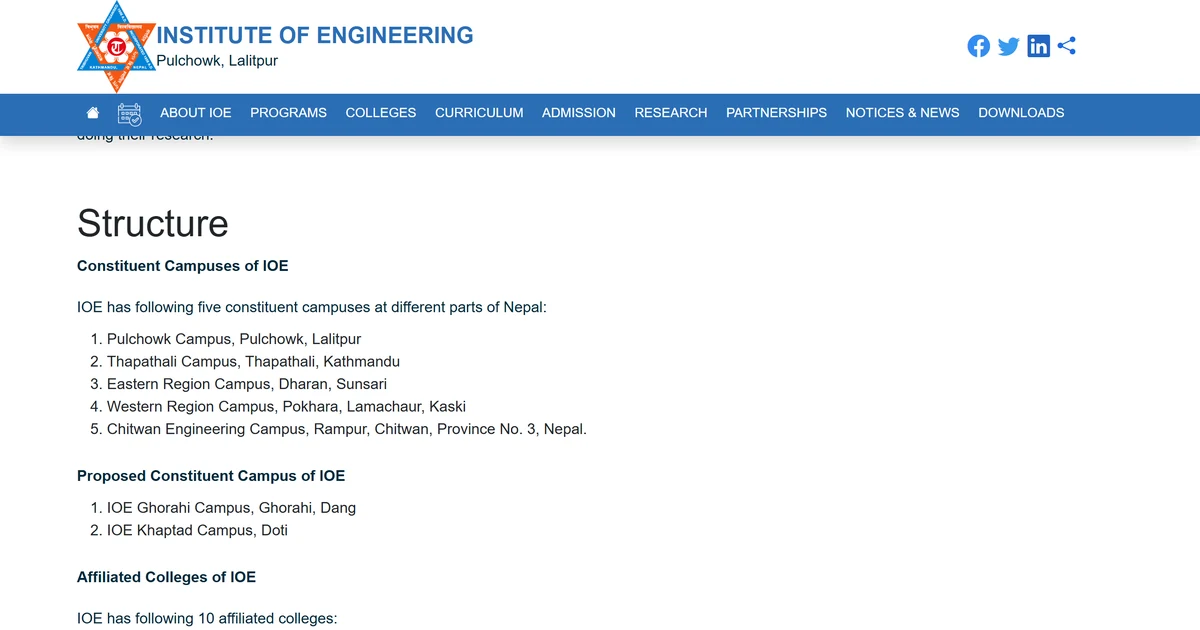
Two IOE sources carry this list and they give different levels of detail. The booklet names the district; Tribhuvan University’s own IOE page gives the street address. They agree on nine of the ten, and the tenth is worth knowing about before you plan a journey.
| College | District (booklet) | Address (IOE at a glance) | Intake 2083 |
|---|---|---|---|
| Kathmandu Engineering College | Kathmandu | Kalimati, Kathmandu | 384 |
| Advanced College of Engineering and Management | Kathmandu | Kupondol, Lalitpur | 336 |
| Kantipur Engineering College | Lalitpur | Dhapakhel, Lalitpur | 288 |
| Himalaya College of Engineering | Lalitpur | Chyasal, Lalitpur | 240 |
| National College of Engineering | Lalitpur | Talsikhel, Lalitpur | 240 |
| Kathford International College of Engineering and Management | Lalitpur | Gwarkho, Lalitpur | 192 |
| Janakpur Engineering College | Bhaktapur | Tathali, Bhaktapur | 192 |
| Khwopa College of Engineering | Bhaktapur | Libali, Bhaktapur | 192 |
| Sagarmatha Engineering College | Lalitpur | Sanepa, Lalitpur | 144 |
| Lalitpur Engineering College | Lalitpur | Chakupat, Lalitpur | 96 |
Scroll the table sideways for Address (IOE at a glance) and Intake 2083.
Which programmes each college actually runs
The same page publishes the intake target broken down by programme, which is the more useful half of it: a college running three programmes is no help if the one you want is not among them. These are the 2083 targets, college by college.
| College | Programmes and seats, 2083 |
|---|---|
| Kathmandu Engineering College | Civil 96 · Architecture 48 · Electrical 48 · Electronics 96 · Computer 96 |
| Advanced College of Engineering and Management | Civil 96 · Electrical 48 · Electronics 96 · Computer 96 |
| Kantipur Engineering College | Civil 96 · Electronics 96 · Computer 96 |
| Himalaya College of Engineering | Civil 96 · Architecture 48 · Electronics 48 · Computer 48 |
| National College of Engineering | Civil 96 · Electrical 48 · Electronics 48 · Computer 48 |
| Kathford International College of Engineering and Management | Civil 96 · Electronics 48 · Computer 48 |
| Janakpur Engineering College | Civil 96 · Electronics 48 · Computer 48 |
| Khwopa College of Engineering | Civil 96 · Electrical 48 · Computer 48 |
| Sagarmatha Engineering College | Civil 48 · Electronics 48 · Computer 48 |
| Lalitpur Engineering College | Civil 48 · Computer 48 |
Read down the columns and the choice narrows sharply for some programmes. Civil and Computer run at all ten. Electronics, Communication and Information runs at eight — Khwopa and Lalitpur Engineering College do not offer it. Electrical runs at only four: Kathmandu, Advanced, National and Khwopa. Architecture runs at two, Kathmandu and Himalaya. So for three of the five programmes, the affiliated sector is much smaller than the list of ten suggests.
How the ten sit against the five constituent campuses
The ten targets sum to 2,304 places. The five constituent campuses together target 2,040, of which only 630 are Regular seats and the remaining 1,410 are Full Fee. So the affiliated sector is slightly the larger half of the system by headcount, and the subsidised Regular seats everybody competes for are under a sixth of the whole system. The ten per cent obligation adds roughly 230 more places priced at the IOE Regular rate, spread across all ten colleges.
Where IOE’s two lists disagree
Nine of the ten entries match across both IOE sources. The tenth is Advanced College of Engineering and Management: the 2083 booklet places it in Kathmandu, and Tribhuvan University’s own IOE page gives its address as Kupondol, which is in Lalitpur. The district count therefore depends on which document you read — six in Lalitpur by the booklet, seven by the at-a-glance page. This answer follows the booklet, because it is the affiliating institute’s current admission document and it is the one the admission process runs on. If you are planning a visit, use the address rather than the district.
Colleges and districts from section 2.6, page 9 of the IOE B.E./B.Arch Booklet 2083. Intake targets and the programme breakdown from the affiliated-college table on page 10, verified against a rendered image of that page because the booklet sets its Nepali in legacy fonts that do not survive copying; each column reconciles with its own printed total and the ten sum to the printed 2,304. Addresses from IOE at a glance on ioe.tu.edu.np, read 31 August 2026. The entry reading "Janakpur Engineering College" is the college that now operates as Imperial College of Engineering, and both sources place it in Bhaktapur.
At Imperial College of Engineering
We are on that list, at 192 places across Civil, Electronics and Computer, on the same terms as the other nine.
Sources
- IOE B.E./B.Arch Booklet 2083published 7 August 2026 · read 31 August 2026
- IOE at a glance, Tribhuvan Universityread 31 August 2026
Last reviewed by Ram Raj Thapa, Admissions Officer, Imperial College of Engineering. Every figure on this page is cited to the document it came from.